
What Actually Helps Adults Finish the Degrees They Start
6 Min Read

For many adults weighing a return to school, the hardest question is not whether they can get in but whether they will make it to the end. A questionnaire conducted on behalf of Brenau University Online surveyed 1,013 U.S. adults, including working adults, parents and current or former students, to understand what makes people believe they will finish a degree once they start, what plants the seed of doubt and which kinds of support move the needle most.
The findings point to a quieter story than the usual conversation about access and admissions. Adults are less afraid of failing to finish than they are of what a degree might cost them, and what builds their confidence is not prestige but flexibility, early momentum and seeing people like themselves succeed.
Key Takeaways
- Losing a job or income is the most common reason adults would stop or pause a degree program (28%).
- Flexible scheduling is the top factor adults say would boost their confidence in completing a degree (63%), followed by a clear career payoff (54%).
- More than 4 in 5 adults (81%) would be more likely to finish at a school that understands working adults.
- Wasting money is the biggest worry about going back to school (66%), well ahead of personal stakes like letting family down (15%).
- Among adults still pursuing a degree, Gen Z is the most career-driven, with 72% saying finishing would open the door to a better career.
Why Cost, Not Failure, Is the Bigger Fear
The conventional worry about going back to school is failing to finish. The data suggests adults are far more afraid of the price tag.
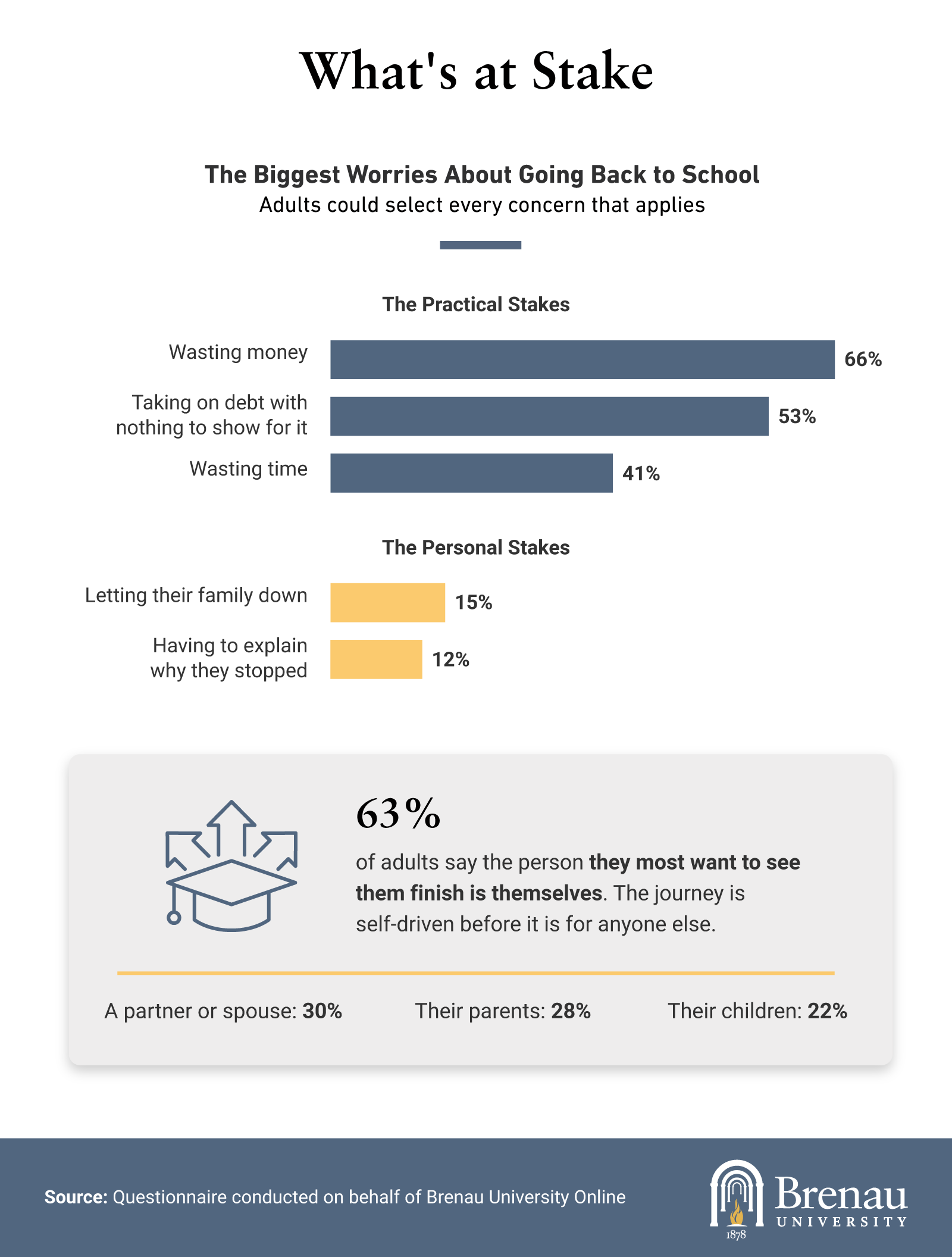
Adult learners said they fear the cost of a degree (61%) far more than not completing it (7%). When asked about their biggest worries, two-thirds (66%) named wasting money, and more than half (53%) cited going into debt. These factors outweighed more personal stakes, such as letting their family down (15%) or having to explain to others why they stopped pursuing a degree (12%).
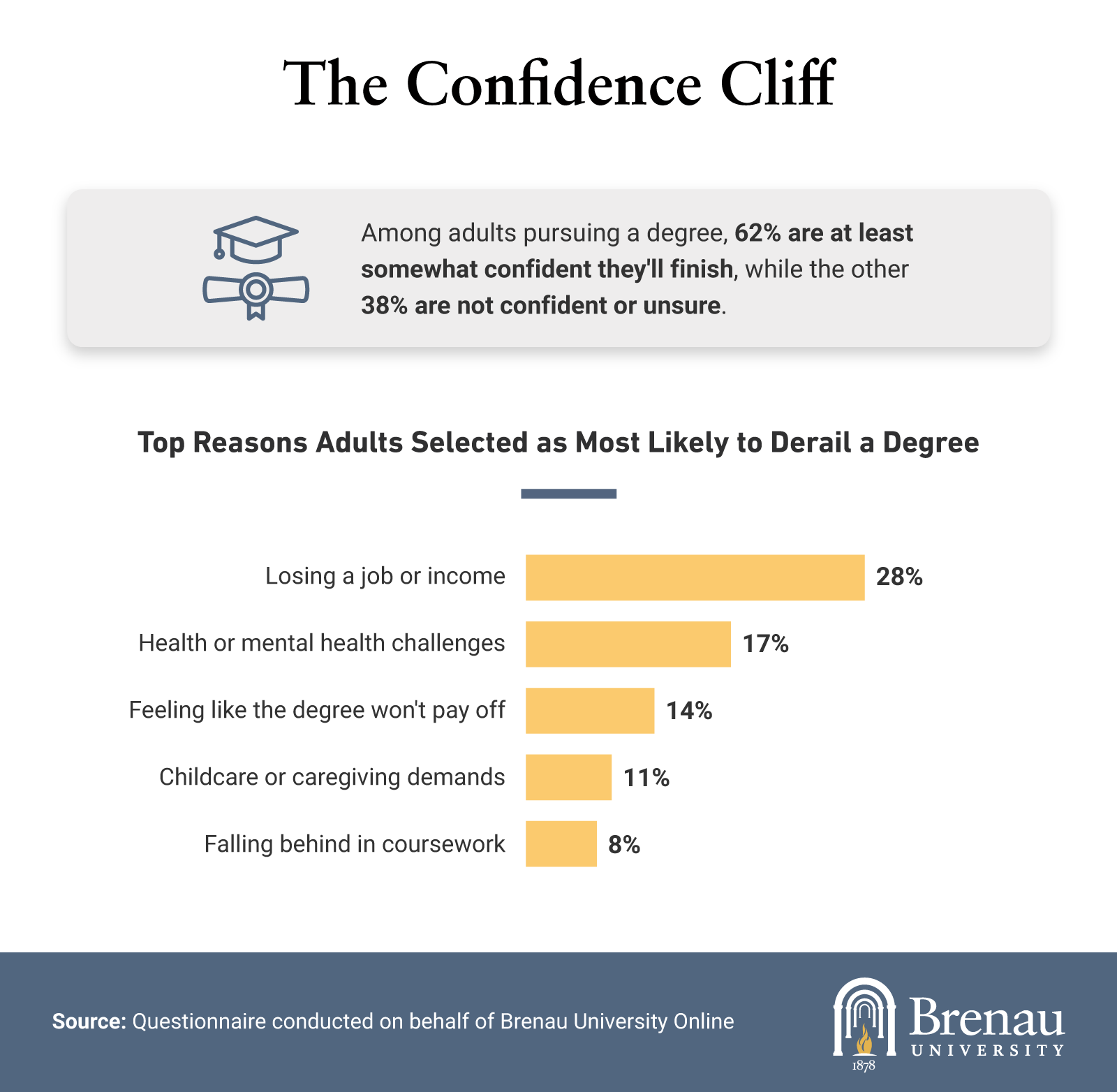
The same financial pressure shows up in what would derail a degree. Losing a job or income is the most common reason adults would pause or stop a degree program (28%), followed by health challenges (14%).
Nearly 2 in 5 adults currently pursuing a degree (38%) are not confident or are unsure about whether they will complete their program. Gen X adult learners are the least sure they will finish, with 46% saying they are not confident, compared with just 13% of Gen Z. More than 1 in 4 adults still pursuing a degree (27%) said they had talked themselves out of enrolling at some point because they did not believe they would finish.
What pulls adults toward completion is often what it could potentially unlock. Nearly half (49%) said finishing a degree would open the door to a better career, a motivation that is far stronger among Gen Z (70%) than baby boomers (30%). Another 45% said it would prove they are capable of more, 34% said it would build a better future for their family and 14% said it would make them a role model for their children.
What Makes Adults Believe They Can Finish
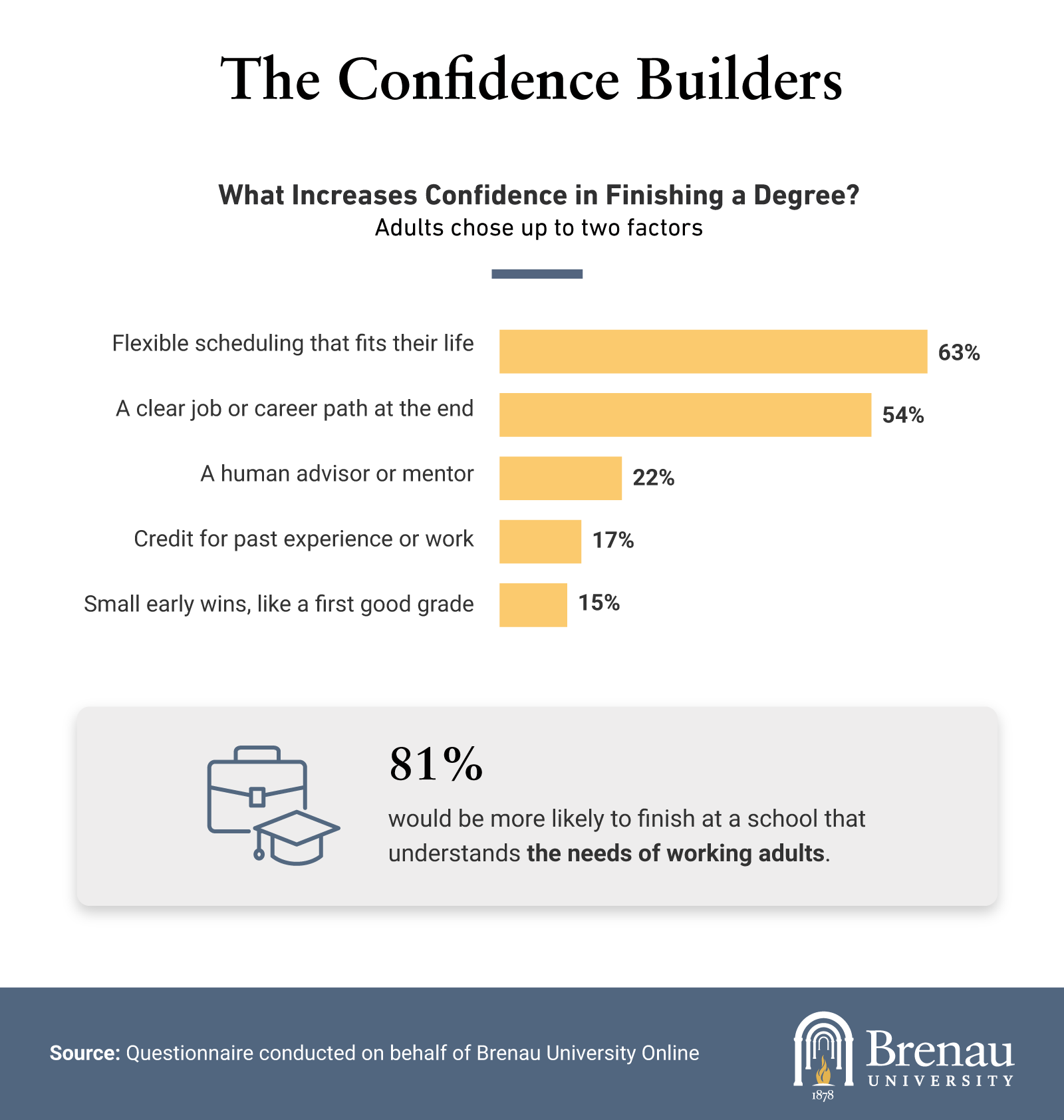
If worry is one side of the story, momentum is the other. Flexible scheduling topped the list of confidence boosters, with 63% of adults saying it would make them more confident about completing a degree. A clear career payoff followed at 54%. Among adults currently pursuing a degree, a defined career path mattered far more to Gen Z (81%) than to Gen X (45%).
More than three-quarters of adults (77%) said scoring some academic successes early on would fuel their motivation to keep going. Role models also matter. More than half of adults (58%) said that seeing students from backgrounds like their own succeed would strengthen their belief that they could do the same.
One finding stood out for any school that serves working adults. More than 4 in 5 adults (81%) said they would be more likely to finish at an institution that understands the realities of working adult life. The majority desire scheduling and support that fit around jobs and families instead of competing with them.
Most adults (91%) agreed that the financial payoff played an important role in their decision to finish a degree, as they looked forward to benefits such as a better job or higher income. Three-quarters of adults (75%) also agreed that finishing their degree was rooted in personal meaning. Program completion allowed them to prove something to themselves, helped shape their identity or created a sense of fulfillment.
Among adults still working toward a degree, just as many said finishing would prove they are capable of more (48%) as those who said it would open the door to a better career (47%). The desire to prove something to themselves sits right alongside the desire to get ahead. Gen Z degree pursuers were far more likely than Gen X to see finishing as a career booster (72% vs. 41%).
What Finishing a Degree Means to Georgia Adults
Brenau’s home state adds a local lens to this story. Georgia adults track the broader mood, but on each point, they land a step above the national figures.
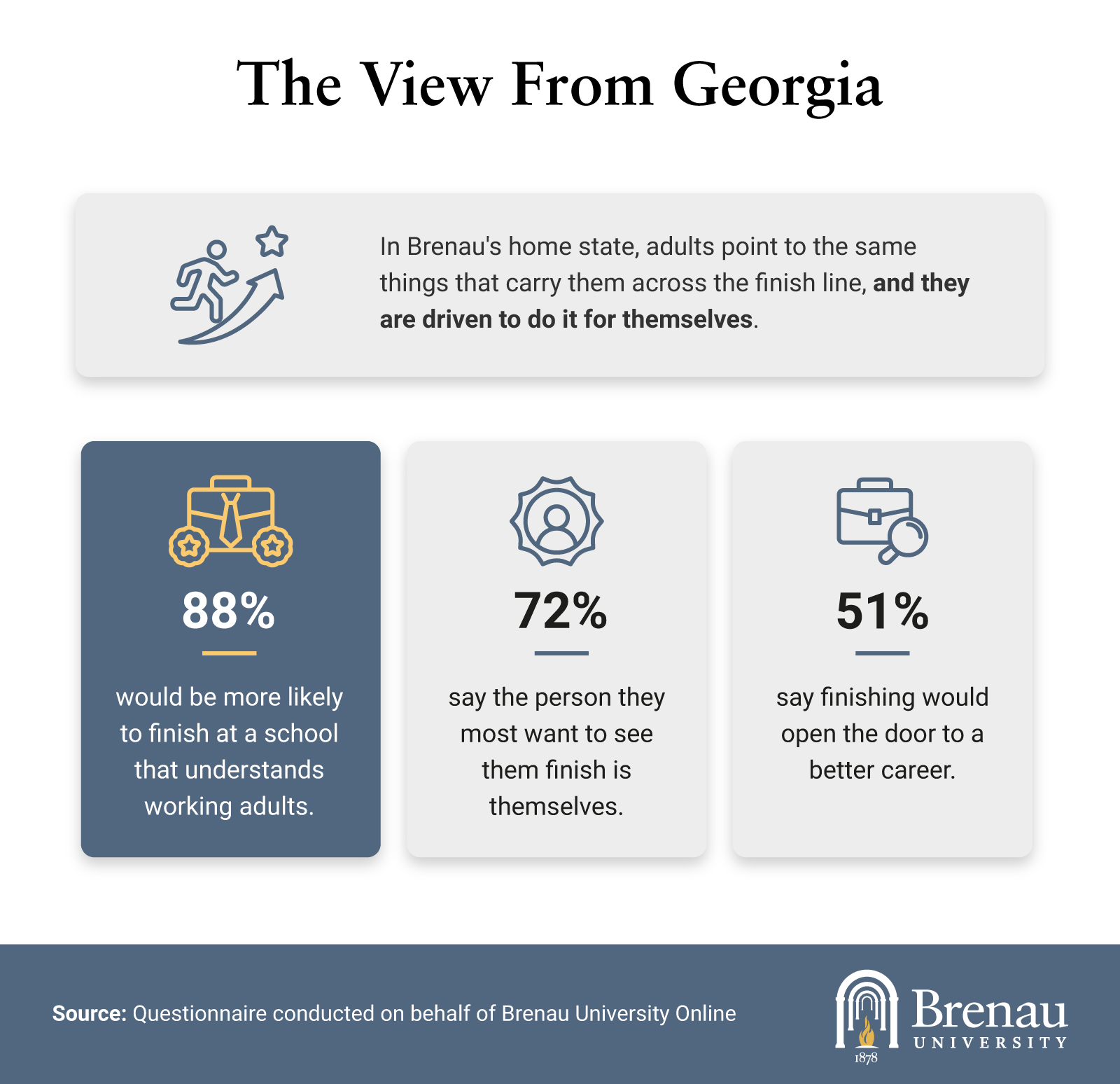
Nearly 9 in 10 Georgia adults (88%) said they would be more likely to finish at a school that understands the needs of working adults, an even larger share than the national figure. And for almost 3 in 4 (72%), the person they most want to see them finish a degree is themselves, with half (51%) also saying a finished degree would open the door to a better career.
What the Numbers Mean for Anyone on the Fence
If you have ever started a degree and stalled, or talked yourself out of starting one at all, the data says you have plenty of company. The pattern in these responses is that adults tie their confidence less to willpower than to the conditions around them: a schedule that bends to your life, a clear reason the effort will pay off and a few early wins.
So before weighing only what a program costs, it is worth asking whether it is actually built for the way you live. The adults who feel most ready to finish are often not the most confident on day one; instead, they are drawn to an environment built to support their confidence and motivation.
Methodology
A questionnaire of 1,013 U.S. adults was conducted on behalf of Brenau University to explore what drives their confidence or doubt that they will finish a degree and which supports most increase their confidence. Respondents were sourced using CloudResearch Connect.
The average age of respondents was 40; 49% were women, 50% were men and 1% self-described or preferred not to say. Confidence in finishing a degree was assessed among the 372 respondents currently pursuing one. Respondents reported their state of residence, and a regional subsample of 43 respondents from Georgia was analyzed separately for the state-level findings. This is a non-scientific, exploratory questionnaire designed to explore behavioral and attitudinal trends and is not intended to represent all adults.
About Brenau University Online
Brenau University has spent more than 140 years preparing students for meaningful careers and lives, with a focus on flexible, supportive learning for working adults. Its online programs offer small classes, flexible scheduling and personalized support, such as academic coaching and career development, all built to fit around work and family. Adults thinking about finishing or advancing a degree can explore what is available and start a path that works on their own schedule.
Fair Use Statement
You are welcome to share the findings from this report for noncommercial purposes. If you do, please credit Brenau University Online with a link back to this page.