
The Reset Button: Why Adults Over 30 Are Starting Their Careers Over
6 Min Read

Career advice tends to assume a straight line. A student picks a field at 18, earns a degree by 22 and climbs steadily from there. For a large share of adults in their 30s and 40s, that line bends well before retirement, and the bend arrives with a mix of financial pressure, professional restlessness and a sense that the work no longer fits the person doing it.
Brenau University designed its online programs around adults who come back to school with jobs, families and full calendars, so the question of what prompts a career restart sits close to home. To understand that turning point, a questionnaire was administered to 503 American adults aged 30 and over about starting a career over and returning to education. Their answers trace when doubt first appears, how long people sit with it and what they now believe about the value of the education that brought them this far.
Key Takeaways
- 84% of adults over 30 have thought about starting their careers over, and 37% have already acted on it.
- Adults over 30 report that the doubt arrives at 33, roughly a decade after finishing school, and pay is the top trigger at 41%.
- Adults over 30 call starting over a fresh start (66%), not a last resort, and 57% of those actively doing it feel more hopeful than before they began.
- 77% of adults over 30 would choose college again, but only 45% would choose the same major.
- AI-proof work is the fastest-rising priority in working life, climbing from 25% at ages 18 to 22 to 62% today.
The Decade-Long Pause Between Doubt and Action
A career restart rarely begins with a resignation letter. It begins with a quieter moment, often years earlier, when the path a person chose in their early 20s no longer matches the life they are living now. The gap between that first flicker of doubt and the first real move turns out to be one of the most revealing parts of the story.
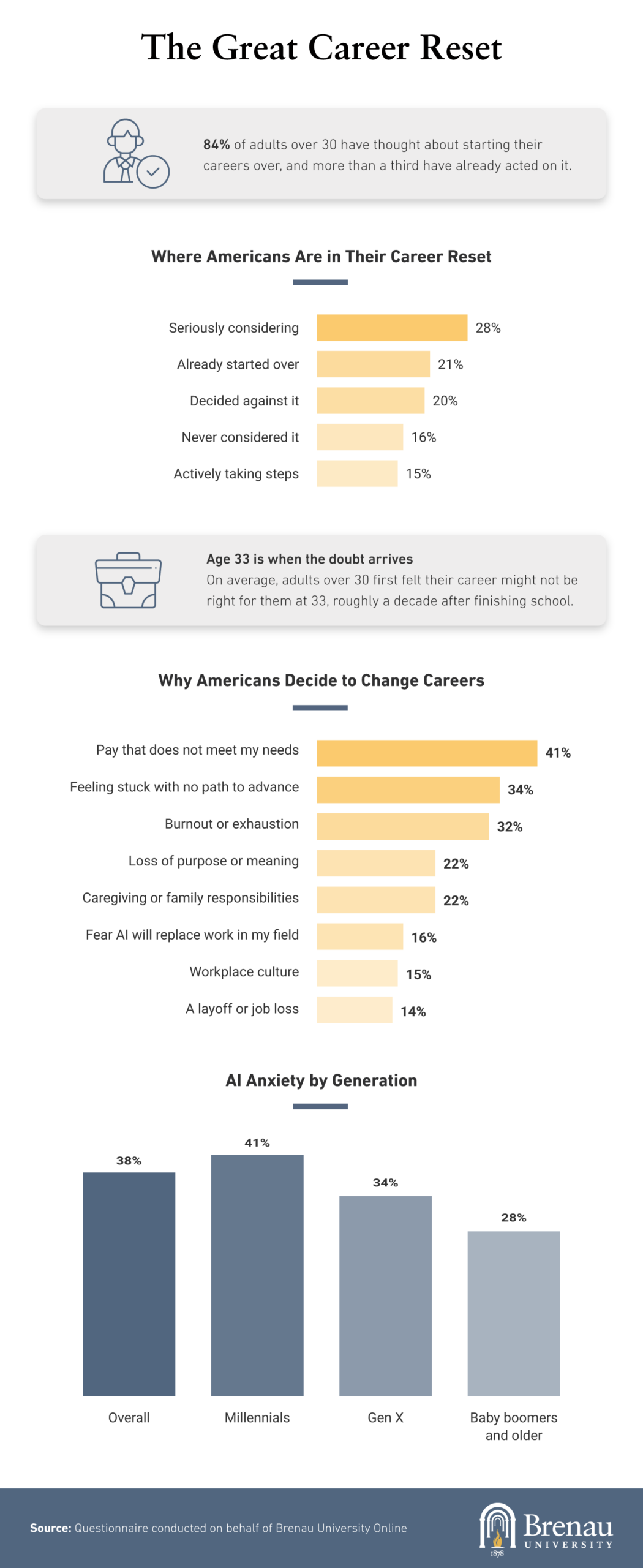
The impulse to begin again is close to universal among older workers. Among adults over 30, 84% have thought about starting their careers over, and 37% have already acted on that thought. The idea, in other words, has moved out of daydream territory and into lived experience for more than a third of this group.
Respondents placed the arrival of that doubt at age 33, roughly a decade after most of them finished school. Money was the strongest trigger, with pay cited by 41% as the leading reason to consider a different direction.
Acting on the feeling took time. Among adults over 30 who are actively starting over, 63% took a first step within two years of the thought occurring, while 36% waited three years or more, and the average delay before taking a concrete step was 3.1 years. That pause is long enough for circumstances to shift and for confidence to waver.
Doubt about timing shaped how respondents viewed their own progress. Nearly half, 46%, worried they had waited too long to change direction, 30% said watching younger colleagues made them question their own choices and 25% reported that their career today does not reflect who they are.
What Career Changers Recommend to Anyone Considering a Reset
Adults who have lived through a career change tend to give practical advice rather than motivational advice. Their guidance centers on protecting income, gathering information and lowering the stakes of the first move. Taken together, the recommendations describe a gradual transition rather than a dramatic exit.
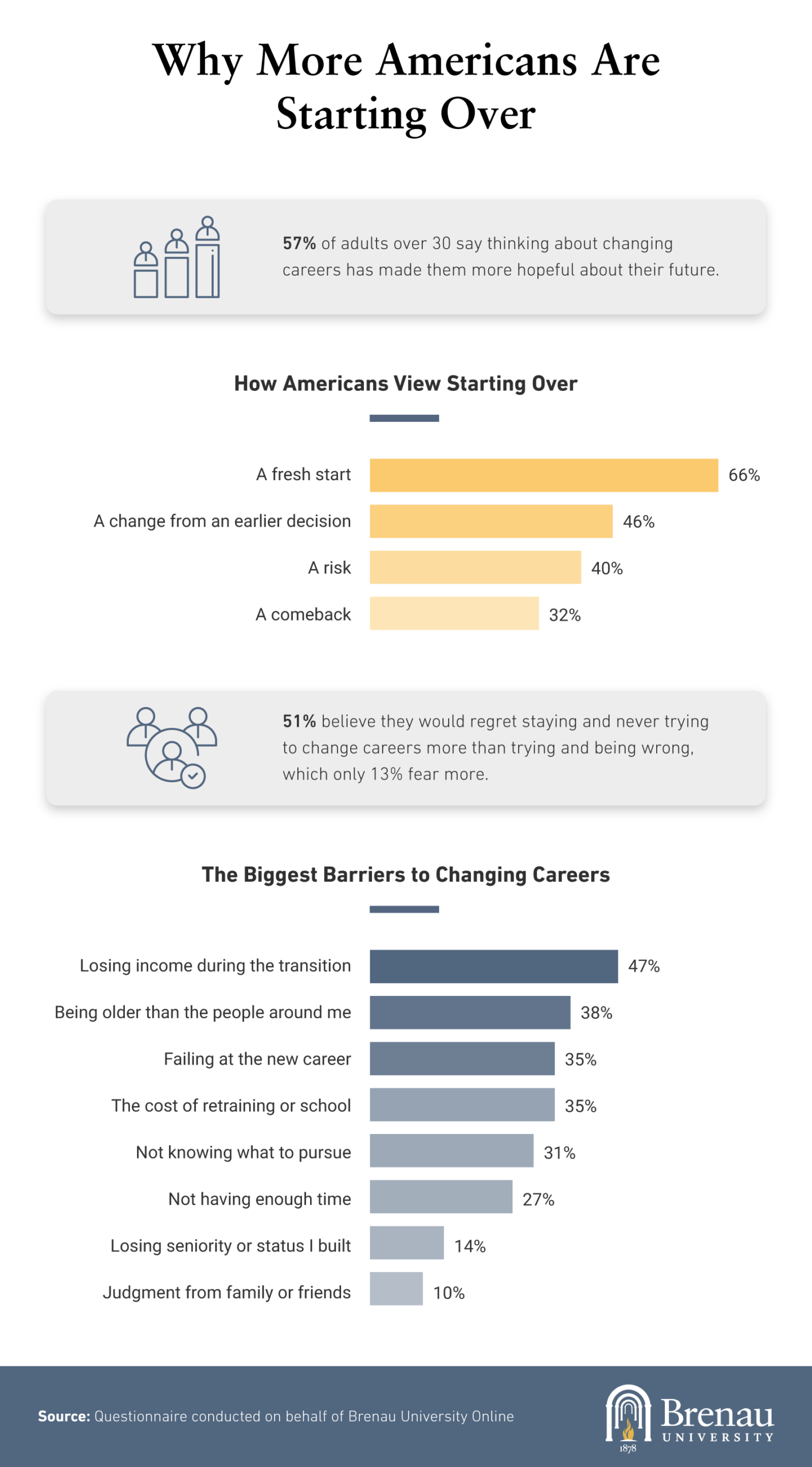
Financial stability anchored the list. The most common recommendation, from 41% of respondents, urged people to keep their current job while making the move, and 38% advised building up savings first. Both suggestions treat a paycheck as the foundation that makes a change survivable. That emphasis mirrors what this group fears most. Losing income during the transition was the single biggest concern, named by 47%, well ahead of every other worry measured.
Research and realistic expectations followed close behind. Talking to people already doing the work under consideration drew support from 35%, and an equal share, 35%, encouraged career changers to prepare for starting at a lower level than they are used to. That willingness to trade seniority for a better fit reflects the long view many respondents have taken.
Testing the idea before committing to it rounded out the advice, with 30% recommending a small trial of the new field through a side project, volunteering or a short course. Low-cost experiments let people confirm their interest before they reorganize their lives around it.
How Adults Judge the Value of Their Education Now
Years of work experience change how people assess the choices they made as students. Distance brings a clearer sense of which parts of a degree held their value and which parts reflected a moment rather than a career. It also brings new criteria, shaped by a labor market that looks different than it did at graduation.
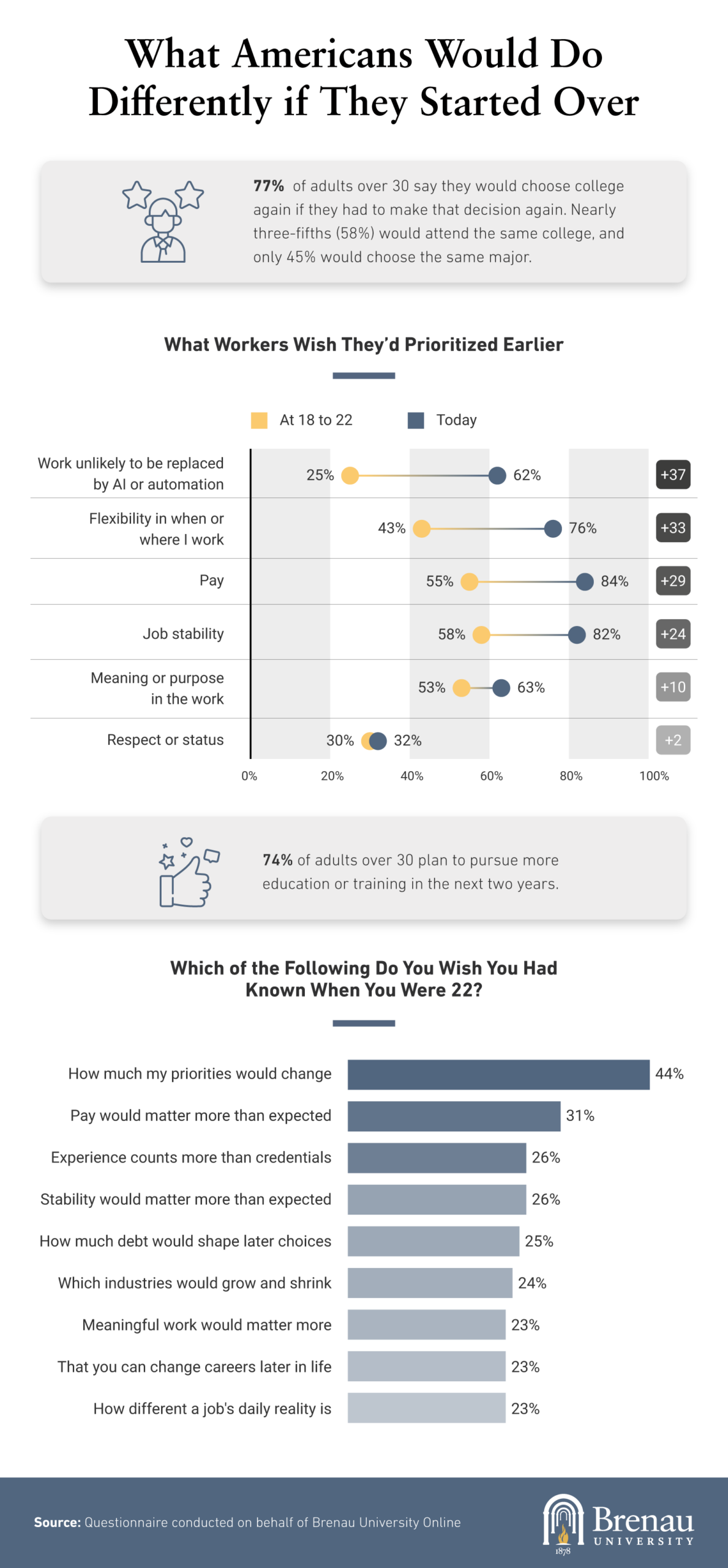
Respondents drew a sharp line between the decision to attend college and the decision about what to study. College itself held up well, with 77% saying they would choose it again, yet only 45% would choose the same major. The credential retained its value, while the specialization within it did not always survive contact with the working world.
Priorities have shifted along with that assessment. Work that resists automation ranked as the fastest-rising priority in working life, climbing from 25% at ages 18 to 22 to 62% today. Durability now competes with pay and passion as a reason to pick one field over another.
Rewriting the Career Timeline
The picture that emerges is one of patience rather than panic. Adults over 30 sat with their doubts for years, weighed the financial risks carefully and leaned on savings, research and small experiments before making a move. Most still believe in the education that started their careers, even as they rethink the specific path it pointed them toward. A career built over decades leaves plenty of room for a second chapter, and the adults in this research are writing theirs with more information than they had the first time.
Methodology
A questionnaire was administered to 503 American adults aged 30 and over about starting a career over and returning to education. Respondents were qualified if they were 30 years of age or older; those under 30 were screened out.
The gender breakdown was women (59%) and men (41%), with the remainder preferring not to answer. The generational breakdown was as follows: millennials (57%), Gen X (31%) and baby boomers and older (12%). On education, 68% held a college degree, including 37% with a bachelor’s degree, 16% with a master’s degree, 12% with an associate degree and 3% with a doctoral or professional degree; 15% had some college but no degree, and 15% had a high school diploma or less.
Respondents were located across 47 states. The questionnaire was conducted in August 2026. All percentages are rounded to the nearest whole number. This was a non-scientific, exploratory questionnaire designed to explore behavioral and attitudinal trends. It is not intended to represent all career changers and prospective students.
About Brenau University
Brenau University has served students from its home in Gainesville, Georgia, since 1878, with a long focus on flexible learning designed for adults who work while they study. Its online programs let students earn a credential without stepping away from the income and responsibilities that make a career change possible.
Fair Use Statement
You are welcome to share these findings for noncommercial purposes, whether in a classroom, a newsroom or a conversation about the future of work. Please credit Brenau University with a link back to this page so readers can review the research.