
The Years That Shape Who Kids Become
6 Min Read

Elementary school teaches children how to learn, and high school prepares them for what comes next. The stretch in between carries a heavier load than its reputation suggests, because students in the middle grades are working out who they are while the academic demands climb. Adults who look back on that period often point to it as the moment their sense of self took shape, for better or worse.
Brenau University prepares educators for exactly that classroom, so the question of what the middle grades require deserves a closer look. To find out how Americans view those years and the teachers who guide them, a questionnaire was conducted that surveyed 656 American adults, including parents, current and former K-12 teachers and adults reflecting on their own schooling. Their responses point to a chapter of education that shapes identity, demands specialized skill and now carries new responsibilities around technology.
Key Takeaways
- 82% of Americans say the middle school years shape who kids become, and 80% say they shape how kids interact with others later in life.
- A quarter of Americans (25%) feel the middle school years were when they changed the most as a person.
- 22% of Americans say a middle school teacher had the strongest, most lasting effect on their life.
- Nearly nine-tenths of Americans (87%) say teaching middle school requires a different set of skills than teaching younger or older students.
- 45% of Americans say there aren’t enough teachers specializing in the middle grades to meet students’ needs.
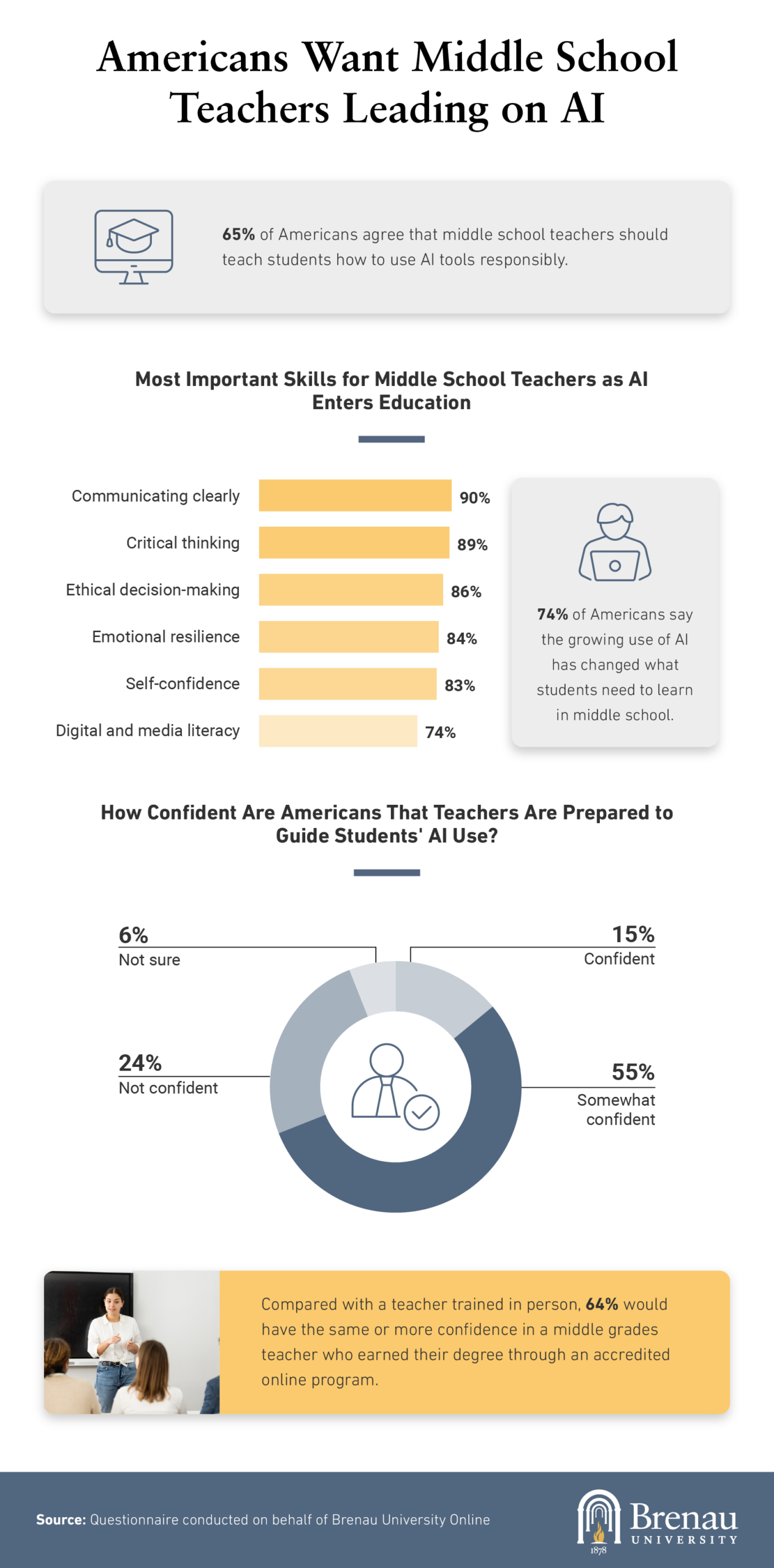
- 65% of Americans say middle school teachers should be teaching students how to use AI tools responsibly.
The Formative Years Few People Prioritize
Ask adults where their sense of self began to form and many trace it to the hallways of a middle school. The social stakes rise, friendships shift and students start testing out who they intend to become. Public opinion recognizes that weight, even as attention and resources tend to gather around the grades on either side.
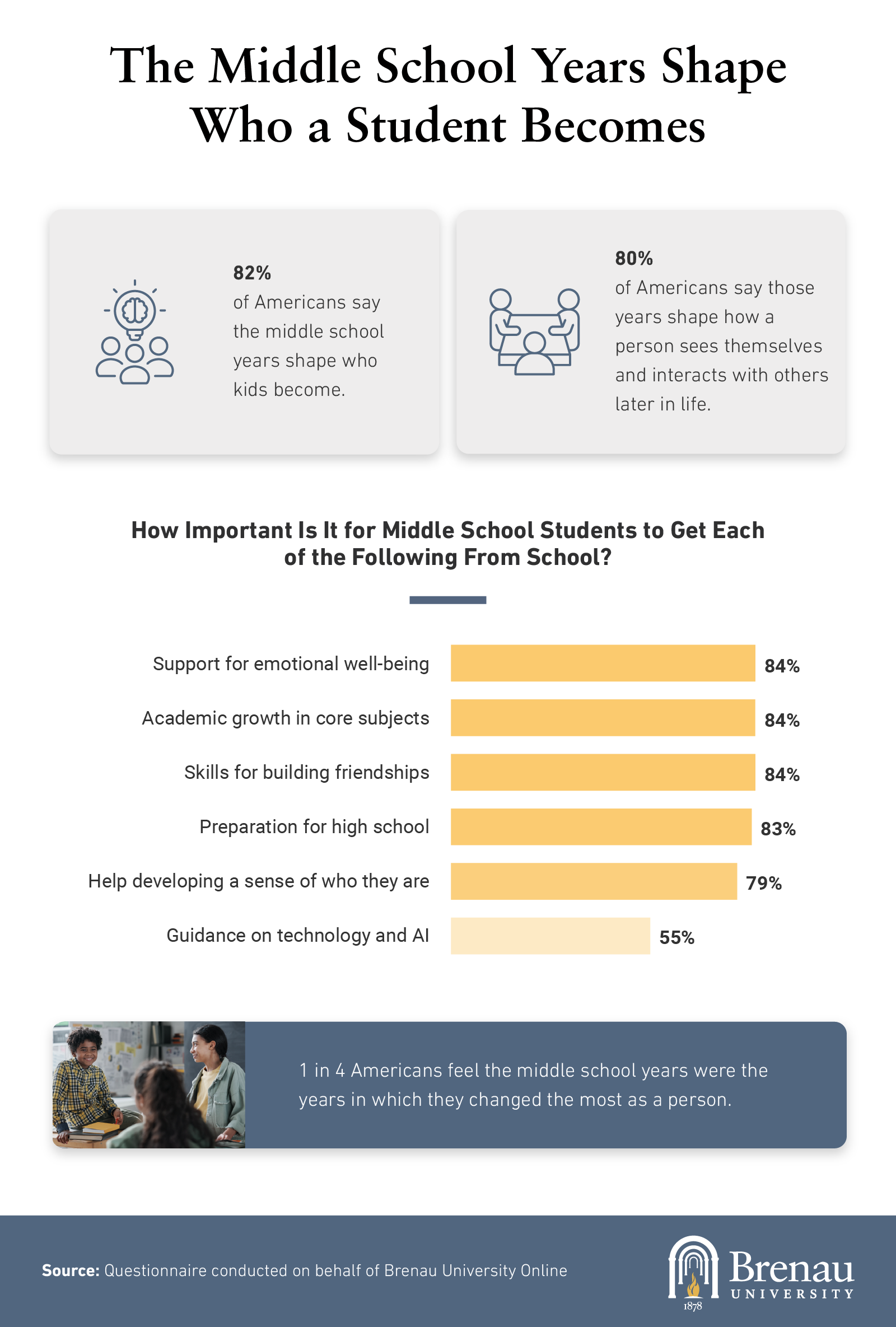
Americans described the middle grades as a turning point in personal development. A strong majority, 82%, said middle school shapes a student’s sense of self, and 80% said it shapes how they relate to others later in life. For 25% of Americans, the middle school years marked the biggest period of personal change in their lives. Few stages of schooling carry that dual influence over identity and relationships at once.
Recognition of that influence has not translated into focus at the top. Policymakers drew the sharpest criticism, with 65% of Americans saying state and national leaders pay too little attention to the middle school years. Schools and districts were cited by 49%, while 40% pointed to parents and families.
Why Teaching Grades 6 to 8 Requires Its Own Skill Set
Managing a classroom of 12-year-olds calls for something other than the techniques that work with second graders or high school seniors. Teachers in these grades handle academic instruction, social conflict and rapid emotional change within the same class period. Americans see that combination clearly and recognize a shortage of educators trained to handle it.
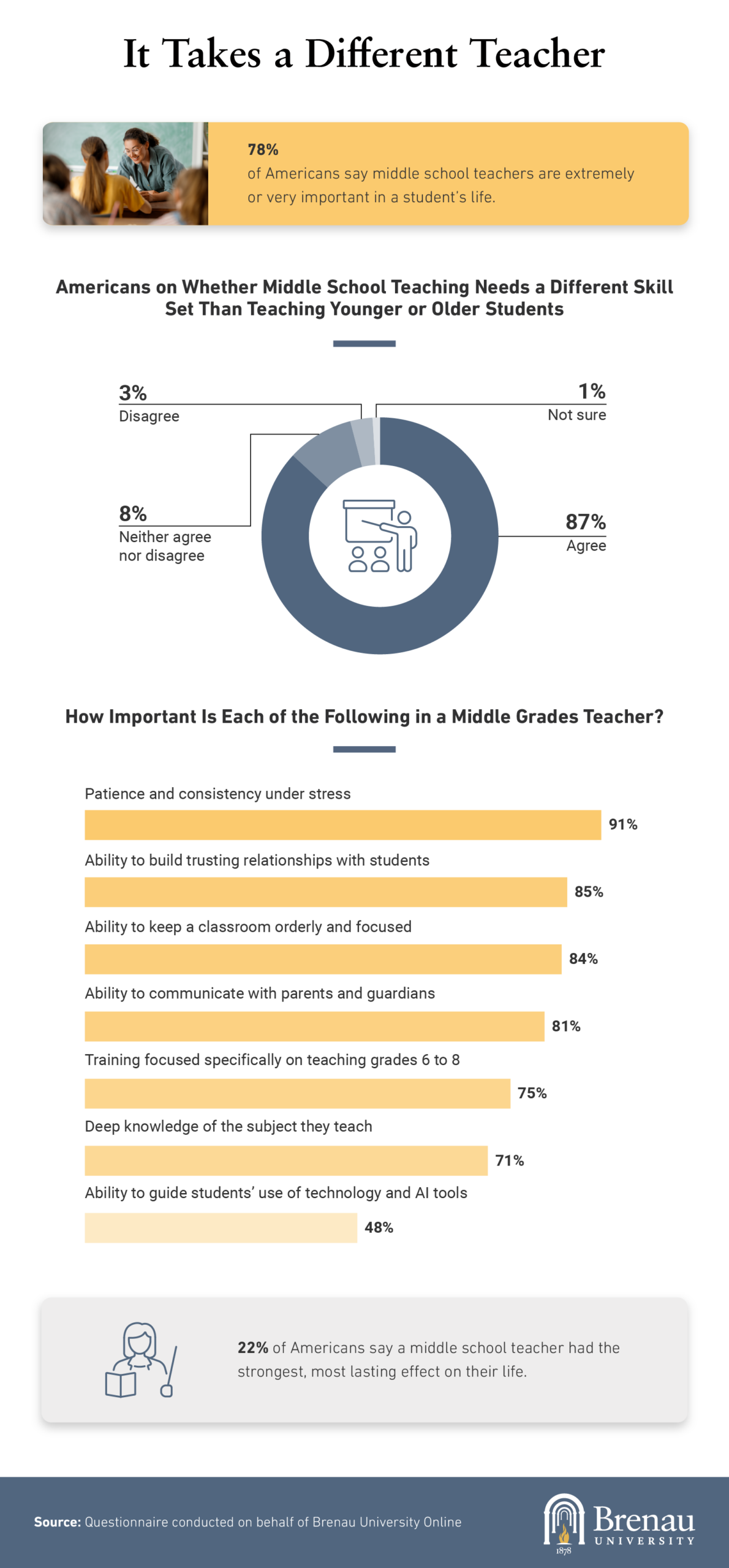
Public agreement on this point was close to unanimous. Nearly 9 in 10 Americans, 87%, said teaching middle school requires a different set of skills than teaching younger or older students. The role asks educators to hold academic rigor and emotional guidance together rather than choosing between them. That weight showed up in the data, with 22% of Americans saying a middle school teacher had the strongest, most lasting effect on their life.
Confidence in the supply of those educators ran much lower. Nearly half of Americans, 45%, said there are not enough teachers specializing in the middle grades to meet students’ needs, while only 21% said the supply is sufficient. That gap points to real demand for teachers who deliberately choose these grades.
What Middle School Teachers Owe Students in the AI Era
Artificial intelligence arrived in classrooms faster than most guidance around it, and middle schoolers are using these tools while they are still learning what honest work looks like. Parents notice the habits forming at home during homework hours. Americans have a clear view of who should be setting the standards.
Use of these tools is already routine for students in the middle grades. Among parents with a child currently in middle school, 70% said that child uses AI tools for schoolwork at least occasionally, including 27% who reported using them a few times a week and 12% who reported daily or nearly daily use. Habits at this scale form well before students reach high school.
Americans want teachers to take the lead on shaping those habits. Nearly two-thirds (65%) said that middle school teachers should teach students how to use AI tools responsibly. Guidance of that kind fits naturally into grades where students are already learning to weigh choices and consequences.
The teachers Americans want leading on AI can come from anywhere. Some 64% said they would have the same or more confidence in a middle-grades teacher who earned their degree through an accredited online program. The path to the credential matters far less to the public than the preparation behind it.
Giving the Middle Grades Their Due
Americans agree that the middle school years shape identity and social skills in lasting ways, yet they see policymakers, districts and families paying less attention to those years than the moment deserves. They also recognize the specialized skill the work requires and the shortage of educators trained for it, along with a new expectation that teachers guide students toward responsible use of AI. Preparation, not pedigree, is what the public associates with a strong middle grades teacher. Students in these classrooms are deciding who they will become, and the adults who meet them there help shape the answer.
Methodology
A questionnaire was administered to 656 American adults about the middle school years and the teachers who work in them. The gender breakdown was women (54%) and men (44%), with the remainder identifying as non-binary or preferring not to answer. The generational breakdown included the following: Gen Z (22%), millennials (46%), Gen X (25%) and baby boomers and older (7%).
On education, 71% held a college degree, including 44% with a bachelor’s degree, 16% with a master’s degree, 9% with an associate degree and 4% with a doctoral or professional degree; 15% had some college but no degree, and 13% had a high school diploma or less. A majority (56%) were parents or guardians, including 23% with a child currently in middle school and 28% with a child who has already completed it. Nearly a quarter (23%) had K-12 teaching experience, including 7% currently teaching, 14% who previously taught and 3% studying to become teachers. The survey was conducted in August, 2026. All percentages are rounded to the nearest whole number.
This was a non-scientific, exploratory questionnaire designed to explore behavioral and attitudinal trends. It is not intended to represent all parents or K-12 teachers.
About Brenau University
Brenau University has prepared educators from its home in Gainesville, Georgia, since 1878, with programs built around adults who balance coursework with jobs and families. Its online Bachelor of Science (BS) in Middle Grades Education program trains teachers specifically for grades four to eight, where academic instruction and adolescent development meet in the same classroom. Students complete coursework online while gaining the field experience Georgia certification requires. For anyone drawn to the years when students figure out who they are, the program offers a direct route into that work.
Fair Use Statement
You are welcome to share these findings for noncommercial purposes, including in classrooms, newsrooms and conversations about the future of middle grades education. Please credit Brenau University with a link back to this page so readers can review the complete research.