
Many Georgians Would Consider Teaching but Don’t Know the Online Path Exists
6 Min Read

Georgia’s classrooms need teachers, but the bigger obstacle to filling those roles may be awareness rather than interest. In a questionnaire conducted on behalf of Brenau University, researchers found that just over half of Georgia respondents have already considered teaching or would under the right circumstances, yet most don’t realize how accessible degree programs have become.
This research aimed to better understand what’s keeping capable people from pursuing a teaching career in Georgia. The data points to pay concerns and unclear pathways holding many Georgians back, not a lack of interest.
Key Takeaways
- The Brunswick-St. Simons metro area offers the state’s highest average teacher salary at $76,960, followed by the Warner Robins ($75,150) and Atlanta ($73,597) metro areas.
- The Albany metro area has the lowest average teacher salary at $60,800.
- In Georgia, 51% of respondents have considered teaching or would consider it under the right conditions, while 12% are currently teachers.
- The Dalton metro area has the highest concentration of elementary school teaching jobs in Georgia, with 17 teachers per 1,000 jobs.
- The Hinesville metro area has the highest concentration of middle school teaching jobs in Georgia, with 13 middle school teachers per 1,000 jobs.
Interest in Teaching Runs High, but Pay Concerns Keep People on the Sidelines
Many Georgians have already considered becoming a teacher, but most stop short of taking the leap. Pay and long-term earning potential are the biggest reasons interest never turns into a career change.
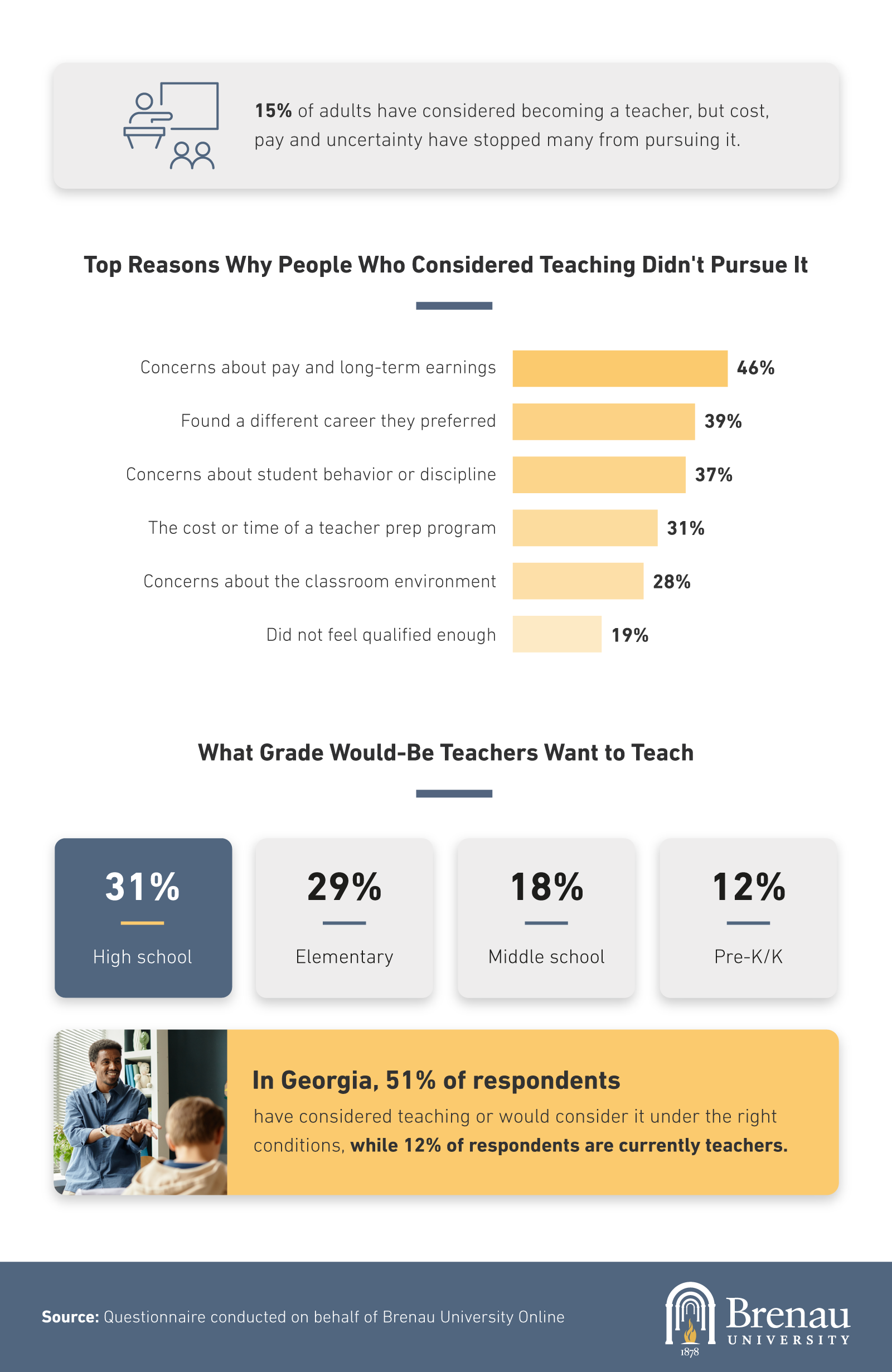
About one in seven American adults (15%) have considered becoming a teacher, and Georgia respondents feel that pull toward the classroom even more strongly. Just over half of Georgia respondents (51%) have either seriously considered teaching or said they’d consider it under the right conditions, while 12% are already teaching.
Pay is the top reason why interest doesn’t turn into a career change. Nearly half of the people who considered teaching but ultimately passed on it pointed to concerns about pay and long-term earnings (46%). Others cited:
- Finding a different preferred career (39%)
- Worries about student behavior (37%)
- Cost or time required for teacher preparation (31%)
Better pay (54%) was the top factor that would encourage more adults to pursue teaching, followed by greater job security (38%) and tuition assistance or loan forgiveness (30%).
The Pathway Problem
For many Georgians, the barrier to education isn’t desire; it’s information. Most don’t realize how much easier certification has become, and that gap in awareness may be doing more to keep people out of the classroom than pay alone.
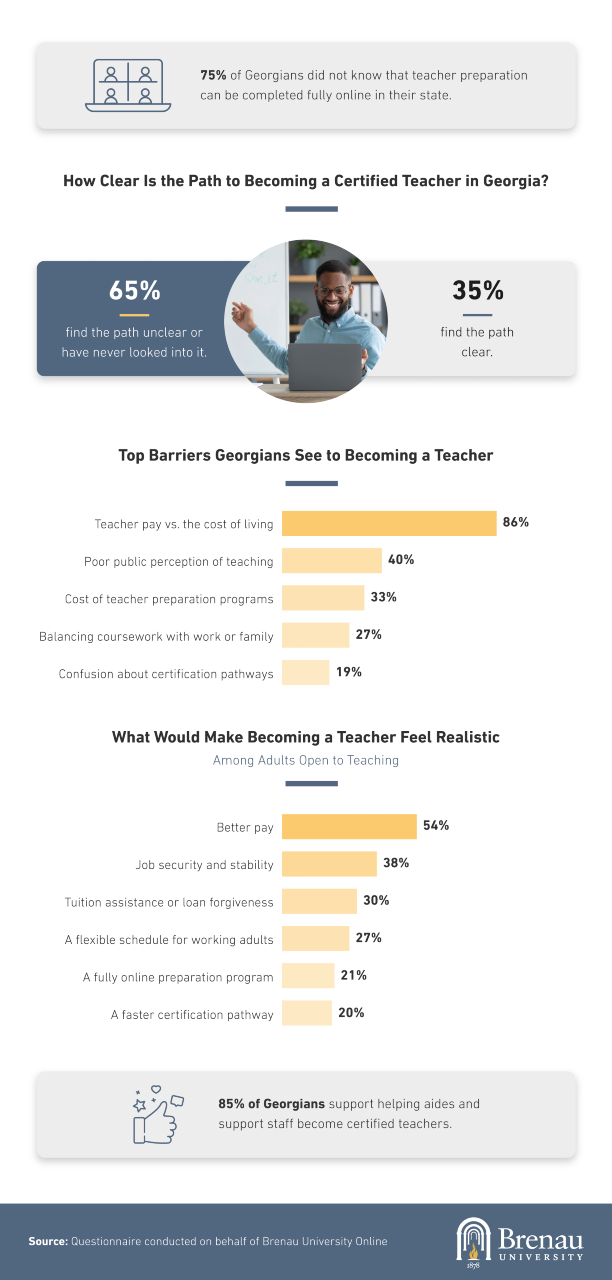
Three in four Georgians (75%) did not realize that teaching programs can now be completed entirely online within the state. Nearly two-thirds (65%) said the path to certification is unclear or admitted they’ve never looked into it. That knowledge gap appears to be a real obstacle standing between Georgians and the classroom.
When Georgians shared what they think is holding people back from the profession, salary topped the list. Eighty-six percent point to pay not keeping pace with the cost of living as the biggest perceived barrier to becoming a teacher, followed by negative public perception of the profession (40%).
One potential solution could be encouraging workers already in the school system. Many Georgia respondents (85%) said they would support policies that create alternative teacher certification pathways for teacher aides and school support staff.
Teacher Pay in Georgia Varies Sharply by Metro Area
Where a teacher works in Georgia can matter as much as what grade they teach. Salaries and job availability can shift significantly from one metro area to the next.
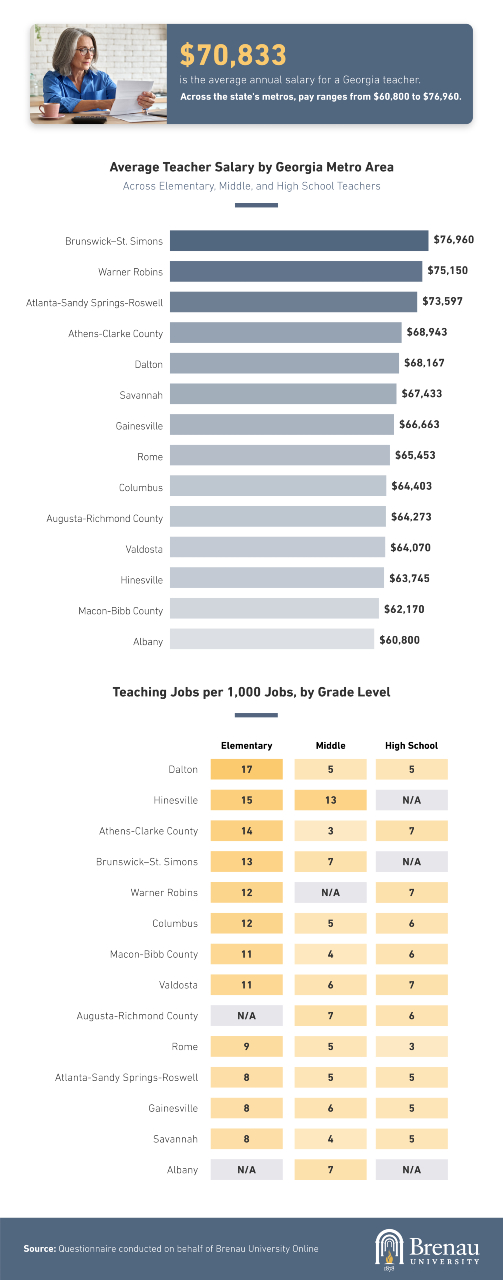
The average Georgia teacher earns about $70,833 per year. On average, high school teachers are paid the most at $72,000, followed by elementary teachers at $70,720. Middle school teachers earn the least at $69,780.
Location matters just as much as grade level. Pay ranges from $60,800 in Albany to $76,960 in Brunswick-St. Simons, which offers the state’s highest average teacher salary. Warner Robins ($75,150) and Atlanta ($73,597) metro areas rank just behind.
Job availability follows its own pattern. Georgia employs about 93,160 general-education K-12 teachers, or roughly 19 of every 1,000 jobs in the state. Dalton has the highest concentration of elementary teaching jobs, with 17 per 1,000 jobs, while Hinesville leads in middle school positions, with 13 per 1,000 jobs.
Closing Georgia’s Awareness Gap Could Fill Its Classrooms
More than half of Georgians are already open to teaching, and public support for expanding pathways into the profession is strong. What’s missing is clear information about how accessible certification has become, particularly through online programs that let career changers train without pausing their current jobs or lives. Closing that awareness gap may be the fastest way to get more qualified teachers into Georgia classrooms.
Methodology
This questionnaire was conducted on behalf of Brenau University and is based on a 2026 survey of 969 U.S. adults. Respondents were grouped by their relationship to teaching: 16% were current teachers, 4% were actively pursuing a teaching career, 15% had seriously considered becoming a teacher, 17% had casually thought about it, 18% would consider it under different circumstances and 30% had never considered it. The sample was 55% millennials, 25% Gen X, 15% Gen Z and 5% baby boomers, and 54% women and 44% men.
Georgia residents made up 12% of respondents and were the only ones asked the Georgia-specific questions about local barriers, pathway clarity, online preparation and state policy. Some questions were shown only to relevant respondents based on their answers, so percentages are calculated against the number of people who actually answered each question rather than the full sample; for questions where respondents could select more than one option, figures are based on those who answered and can total more than 100%.
Teacher salary and employment data come from the U.S. Bureau of Labor Statistics (BLS) Occupational Employment and Wage Statistics program (May 2025), covering general-education elementary, middle and secondary school teachers (excluding special education and career/technical roles), at both the Georgia statewide and metro-area levels. Statewide and metro-area salary figures are simple averages of the reported grade-level mean wages, with no employment weighting. Employment counts and jobs-per-1,000 figures are reported directly by BLS and left unadjusted; some metro and grade combinations are omitted where BLS did not publish an estimate.
About Brenau University
Brenau University offers accessible, career-focused online programs designed for adult learners balancing work, family and education. For prospective Georgia teachers, Brenau’s online education programs offer a flexible path into the classroom without requiring a pause on current jobs or responsibilities. Learn more about Brenau University’s online Bachelor of Science in Elementary Education degree today.
Fair Use Statement
This data is available for noncommercial use with proper attribution to Brenau University and a link back to this page.